In 2025 the BMC awarded two Research grants, one Community Mycology grant, and two Scholarships. Below, the recipients describe how they used the funds provided by the BMC and share some thoughts on their experiences, challenges, and aspirations.
Grants
Research: Julius Tabin
Understanding the Molecular Basis of Entomophthora muscae Behavioral Manipulation.
I have been studying fruit flies infected by the fungus Entomophthora muscae. Over the course of infection, E. muscae enters the fly’s brain and induces striking behavioral changes, causing the flies to “summit” (increase their activity and climb to an elevated point) before death. My goal is to determine the molecule (or molecules) that E. muscae uses to manipulate its host. Previously, I identified nine fungal proteins that might be responsible for this by analyzing the proteins present in fly heads over the course of infection. To test whether any of these proteins can cause summiting on their own, I used the well-developed genetic tools in fruit flies to create fly lines that can produce each fungal protein without needing to be infected. I then bred these flies with other fly lines that allow the proteins to be produced specifically in the flies’ neurons and only when they are kept at a warm temperature (29°C), but not at a cooler temperature (18°C). I developed a method to detect unusual increases in fly activity when the temperature is raised and was ready to begin testing, but I ran into an unexpected challenge: the genetic element that was supposed to turn on protein production in the neurons did not work and the proteins were not produced. Currently, I am in the process of swapping the non-functional copy for a working version. Once this is complete (soon!), I will be able to test whether each of these fungal proteins alter fly behavior and hopefully identify the molecular mechanism behind this fascinating interaction.

Note: Julius is a PhD student in the Department of Organismic and Evolutionary Biology of Harvard University, in the laboratory of Professor Carolyn Elya.
Research: Nick Milam
Investigating the Effects of Electric Currents and Low-Frequency Vibrations on Stropharia rugosoannulata Cultivation Utilizing Spent Grain Substrate.
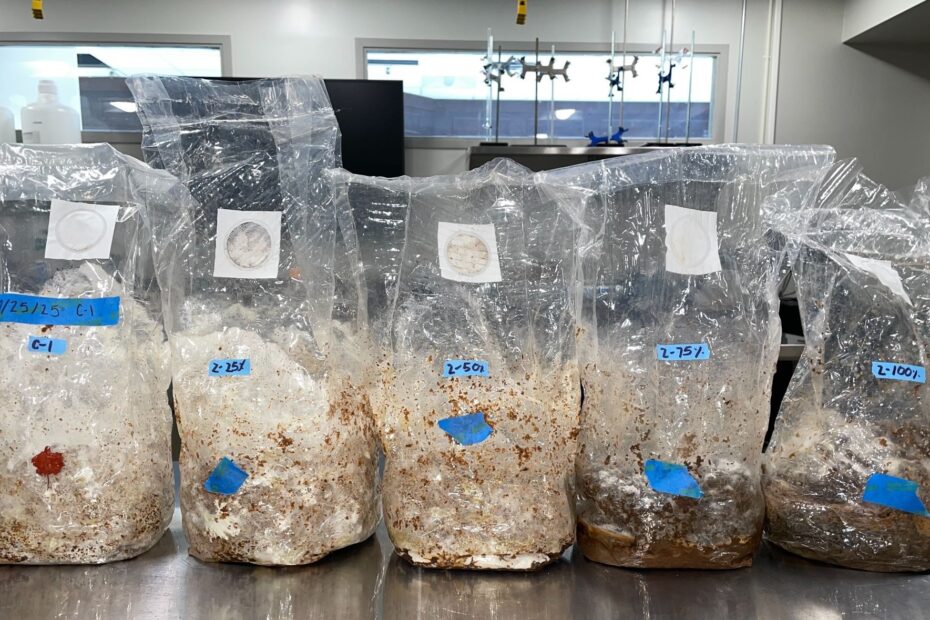
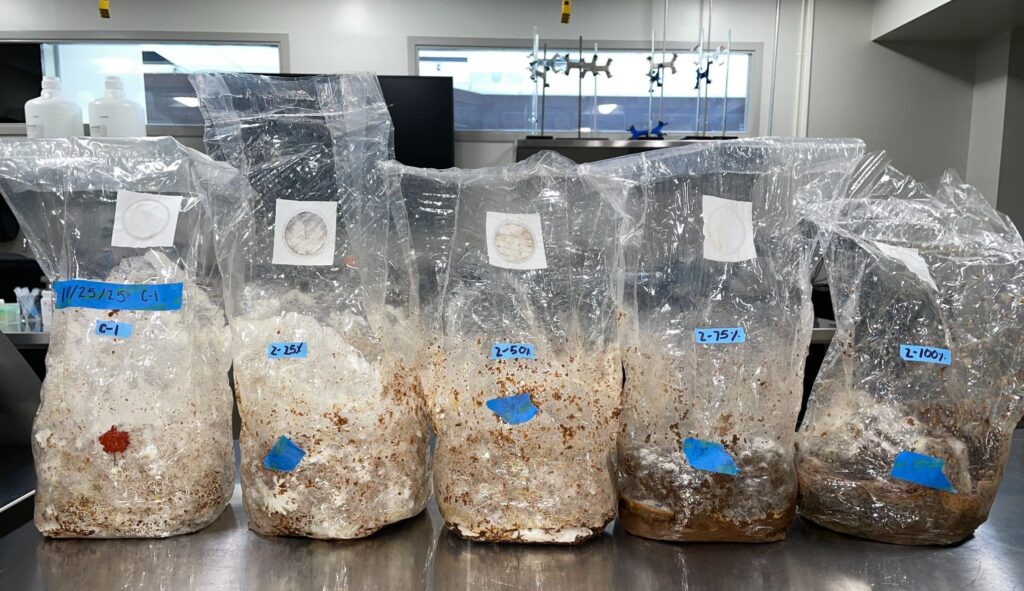
During my final semester at Appalachian State University, I conducted an experiment in the Chemistry and Fermentation Science program to evaluate how different ratios of spent brewing grain affect the cultivation of Stropharia rugosoannulata. The first phase focused on identifying a workable supplementation range. I found that a 1:4 spent brewing grain (SBG) to oak treatment outperformed the higher SBG supplementation groups (2:4, 3:4) and the 100% SBG condition in colonization rate. However, it did not outperform the control substrate (1:4 wheat bran to oak). Based on that pattern, I suspect this strain of Stropharia rugosoannulata may have an optimal supplementation range similar to what has been reported in the literature (roughly 20 – 25%), but that inference is not conclusive without biological efficiency and yield from the repeated experiment.
Since graduating, I have continued into the second phase of the project, exposing the fungus to electrical and sound stimuli designed to mimic aspects of a thunderstorm. This phase asks whether the combined stimuli can synergistically increase growth rate, and whether any improvement can be maintained on spent grain supplemented substrates to match or outperform conventional formulas.
If supported, this work could help establish a scalable approach for converting a brewing industry waste product into efficient edible mushroom production, potentially lowering costs and improving yields for growers and community-scale initiatives. In parallel, I am applying to master’s programs in applied mycology, with a top choice at Cranfield University’s Magan Centre of Applied Mycology, where I plan to expand this work from cultivation to biomaterial production.
Note: Nick graduated from Appalachian State University in December 2025 with a Bachelor of Science degree in Biology, with a concentration in Ecology, Evolution, and Environmental Biology.
Community Mycology and Outreach: Clancy Larmour
Video Reports from the Mycological Society of America
My project aimed to create a series of videos to showcase the Mycological Society of America’s Annual Meeting and many of the attendees. This ranged from well established mycologists to many who, like me, were attending their first large academic conference. As of right now, two of the four videos have been released detailing the meeting itself, as well as a series of interviews with veteran mycologists including the BMC’s very own David Hibbett.
These videos cumulatively reached over 500 views, reaching audiences in the mycology world through the BMC as well as in a series of articles in MSA’s Inoculum newsletter. The remaining videos are currently in production touching on deeper topics within mycology: education and mentorship in the field.
On a personal level, I felt that attending the meeting and being able to showcase a part of mycology was something that mattered, producing the sort of content I wish I had seen in my freshman year of college. Filming while navigating a conference for the first time was a challenge, but it ended up bringing more spontaneous moments to the forefront. Looking forward, I hope to release the remaining videos while finding further opportunities to showcase mycology at events, working more closely with my local area’s Mid-Atlantic States Mycological Conference and at this year’s MSA Annual Meeting. I am truly grateful to the BMC for making this project possible.
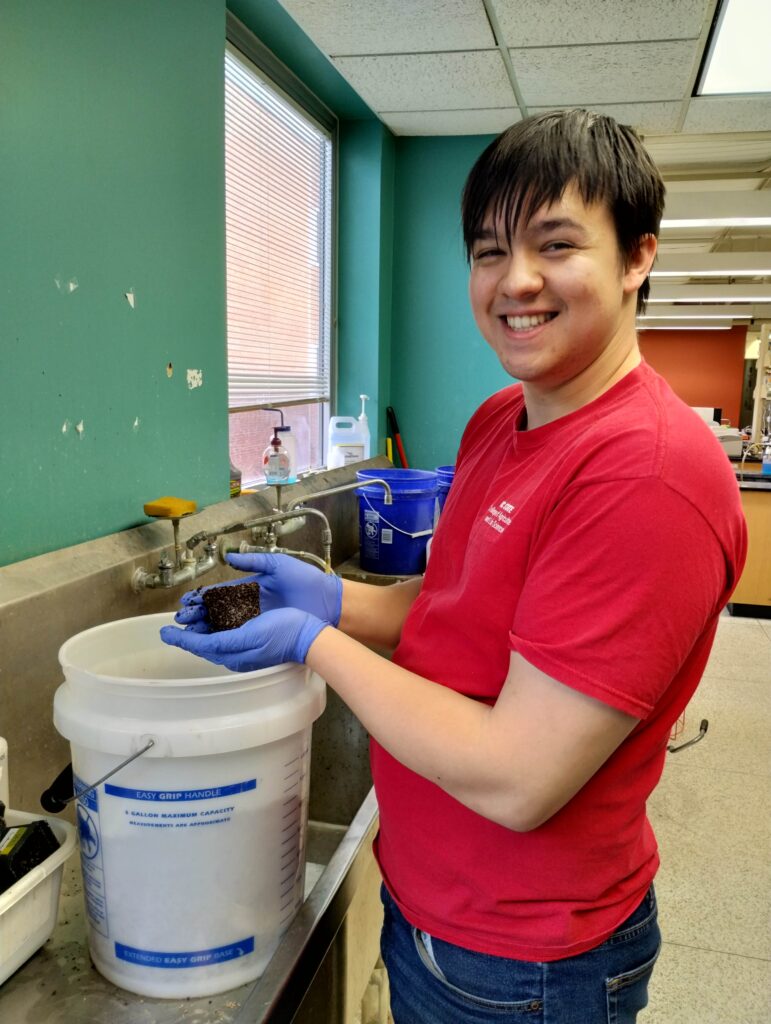
The videos can be found at the CraterAlias YouTube Channel including:
Scholarships
Maria Pinto, NEMF Foray, Ithaca, NY, September 2025
I was able to attend Northeast Mycological Federation’s annual foray in Ithaca, NY last September due to generous support from the BMC. Though I had wanted to attend for years, this was my first NEMF! At the foray, I was present for talks by Arleen Bessette and Bill Yule, both of whom were able to teach me more in two sentences of their lived experience with fungi than I could learn on my own in a day. The exaggeration, if it exists here, is slight. I’ve already incorporated lessons gleaned from these talks into my walks at Arnold Arboretum (as in “let’s take a minute to admire the ubiquity of the pleasing fungus beetle” or “it’s not just the stickiness of that stinkhorn muck that gets ‘em, it’s the laxative in the spores!”). I will certainly be applying what I learned in their sessions and at the ID tables in Ithaca in the year to come, on pop-up walks I’ll offer, free of charge, to members of BIPOC communities in greater Boston. At NEMF, I also led a workshop on science communication and set up a table with a display about my then-forthcoming book, which garnered pre-orders. While dry weather made the going slow in terms of the fleshy, charismatic stuff, so many of us can’t do without, my first NEMF was certainly one for the books.
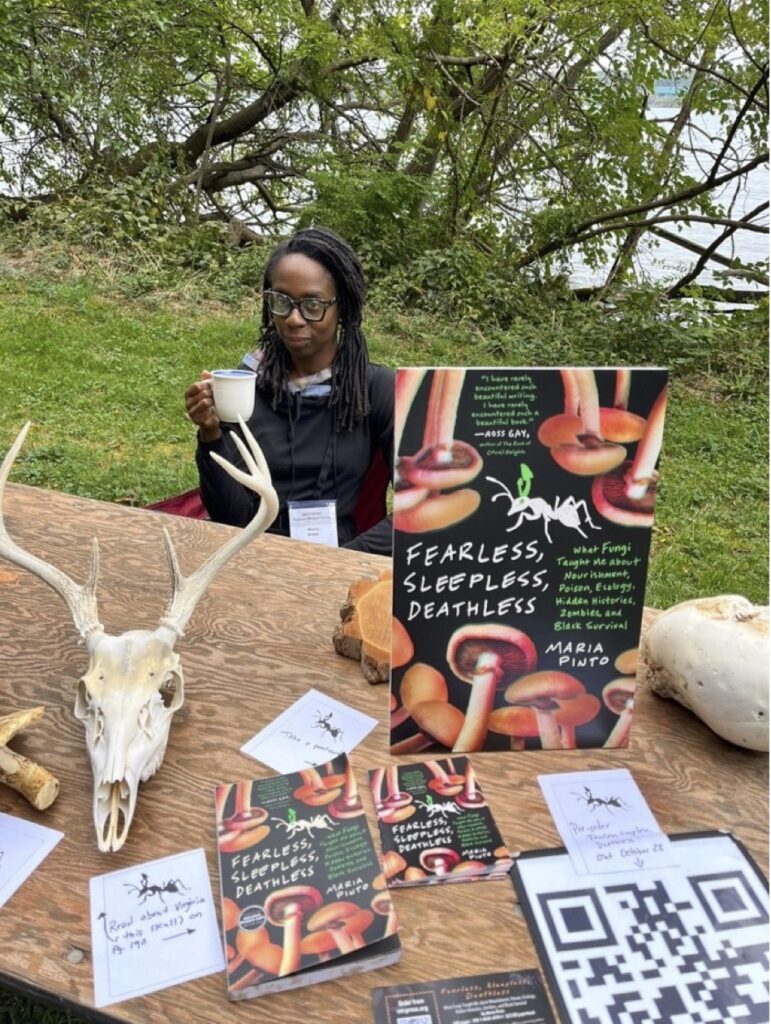
Note: Maria’s book, Fearless, Sleepless, Deathless, was published in October 2025 by the Unviersity of North Carolina Press.
Deana Thomas, NAMA Foray, Marlboro, VT, September 2025
Much like the mycelial networks that hold living systems together, the NAMA Foray felt like a grand tradition of mycological knowledge exchange, where curiosity, skill, and wonder flowed through the community like nutrients. I learned about Cortinarius, dark taxa, and networks among Mexican mycologists and so MUSH more. Patty Kaishian’s book reading and discussion inspired me to feel a new sense of hope for the future and a deeper appreciation for how fungi can become our greatest teachers. These experiences continue to inform not only how I learn about fungi but also how I think about learning itself. I brought a new focus to my work with BMC and RImycoS and local conservation. I look forward to future mushroom hunts and learning more with others. Studying fungi does not have to be done alone, and I am grateful for the scholarships’ support. I hope to keep exploring fungi with my new fungal friends from the NAMA foray. Thanks, BMC!